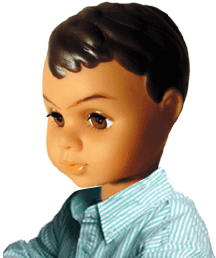
Following up on my
earlier post on Burquad Barbie, here is the real thing. The
Fulla Doll has brown eyes, modest dress and a portable pink prayer map. Invented in Syria, the Fulla Doll has filled a nitch in the market throughout the Middle East. I wonder if there is an equivalent Ken?
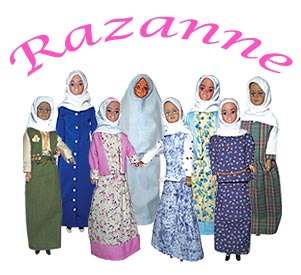
Many Muslim-Americans prefer Razanne doll with her long-sleeved dresses and head scarf which was created by Ammar Saadah, the founder of the NoorArt Inc. with his wife. Razanne has the body of a pre-teen and comes in three types: fair-skinned blond, olive-skinned with black hair, or black skin with black hair.
In the United States, Barbie maker, Mattel markets a

Moroccan Barbie and sells a collectors doll named Leila (and a pregnant Barbie). Leila's elaborate costume and tale of being taken as a slave in the court of a Turkish sultan are intended to convey the tribulations of one Muslim girl in 1720s. "It is no surprise that they'd [Mattel] tried to portray a Middle Eastern Barbie either as a belly dancer or a concubine" said Saadeh adding that countering such stereotypes was one of his goals. Razanne's doll sells around 30,000 yearly. Some Islamic Middle Eastern countries are likely to be attracted to "Praying Razanne" who comes with a long
hijab and modest prayer gown. Iran's version of Barbie and her husband Ken was launched 2 years ago with the names Sara and Dara.
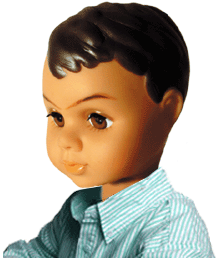 And finally meet Dara and Sara, Iran's answer to Ken and Barbie.
The Muslim dolls have been developed by a government agency to promote traditional values, with their modest clothing and pro-family backgrounds.
They are widely seen as an effort to counter the American dolls and accessories that have flooded the Iranian market
Toy seller Masoumeh Rahimi welcomed the dolls, saying Barbie was "foreign to Iran's culture" because some of the buxom, blonde dolls have revealing clothing.
She said young girls who play with Barbie, a doll she sees as wanton, could grow into women who reject Iranian values.
"I think every Barbie doll is more harmful than an American missile," Ms Rahimi said.
Dara and Sara were born as characters in school books and their lives have also grown in stories that are being sold on cassette along with the dolls.
They have been developed and are being marketed by the Institute for the Intellectual Development of Children and Young Adults, a government agency affiliated with the Ministry of Education.